Brazilian evidence-based guideline for screening, diagnosis, treatment, and follow-up of metabolic dysfunction-associated steatotic liver disease (MASLD) in adult individuals with overweight or obesity: A joint position statement from the Brazilian Society of Endocrinology and Metabolism (SBEM), Brazilian Society of Hepatology (SBH), and Brazilian Association for the Study of Obesity and Metabolic Syndrome (Abeso)
Metabolic dysfunction-associated steatotic liver disease (MASLD), previously known as Nonalcoholic fatty liver disease (NAFLD), is one of the most common hepatic diseases in individuals with overweight or obesity. In this context, a panel of experts from three medical societies was organized to develop an evidence-based guideline on the screening, diagnosis, treatment, and follow-up of MASLD.
Material and methods:
A MEDLINE search was performed to identify randomized clinical trials, meta-analyses, cohort studies, observational studies, and other relevant studies on NAFLD. In the absence of studies on a certain topic or when the quality of the study was not adequate, the opinion of experts was adopted. Classes of Recommendation and Levels of Evidence were determined using prespecified criteria.
Results:
Based on the literature review, 48 specific recommendations were elaborated, including 11 on screening and diagnosis, 9 on follow-up, 14 on nonpharmacologic treatment, and 14 on pharmacologic and surgical treatment.
Conclusions:
A literature search allowed the development of evidence-based guidelines on the screening, diagnosis, treatment, and follow-up of MASLD in individuals with overweight or obesity.
Brazilian evidence-based guideline for screening, diagnosis, treatment, and follow-up of metabolic dysfunction-associated steatotic liver disease (MASLD) in adult individuals with overweight or obesity: A joint position statement from the Brazilian Society of Endocrinology and Metabolism (SBEM), Brazilian Society of Hepatology (SBH), and Brazilian Association for the Study of Obesity and Metabolic Syndrome (Abeso)
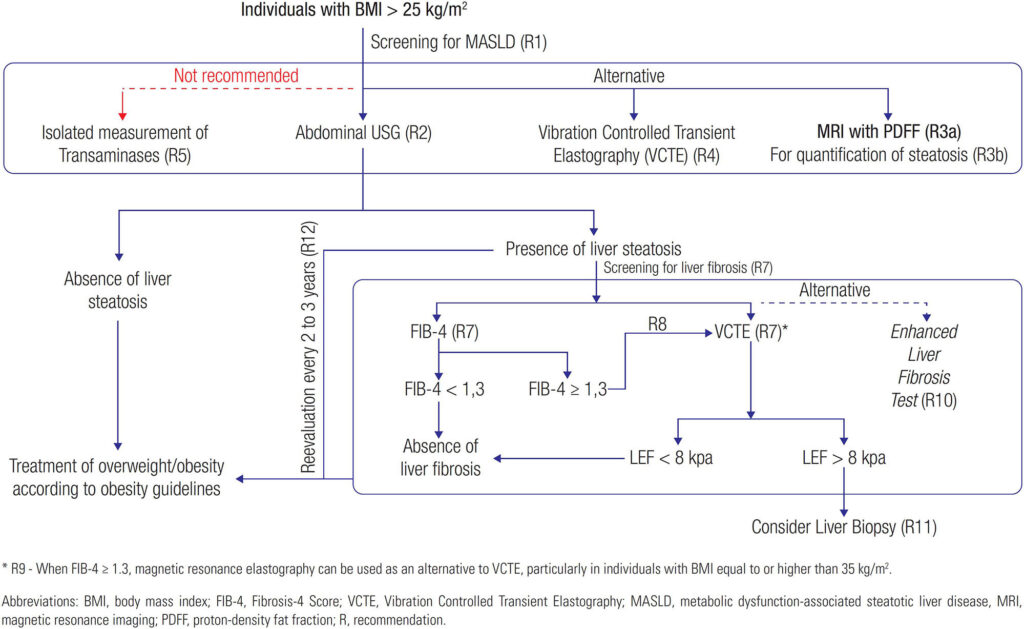
Algorithm for clinical assessment of patients with overweight or obesity and clinical suspicion of metabolic dysfunction-associated steatotic liver disease.
MoreiraRO, ValerioCM, Villela-NogueiraCA, CercatoC, GerchmanF, LottenbergAMP, Godoy-MatosAF, et al. Brazilian evidence-based guideline for screening, diagnosis, treatment, and follow-up of metabolic dysfunction-associated steatotic liver disease (MASLD) in adult individuals with overweight or obesity: A joint position statement from the Brazilian Society of Endocrinology and Metabolism (SBEM), Brazilian Society of Hepatology (SBH), and Brazilian Association for the Study of Obesity and Metabolic Syndrome (Abeso). Arch. Endocrinol. Metab. 2023;67(6):e230123.
Moreira,Rodrigo Oliveira; Valerio,Cynthia Melissa; Villela-Nogueira,Cristiane Alves; Cercato,Cintia; Gerchman,Fernando; Lottenberg,Ana Maria Pita; Godoy-Matos,Amélio Fernando; Oliveira,Ricardo de Andrade; Mello,Carlos Eduardo Brandão; Álvares-da-Silva,Mário Reis; Leite,Nathalie Carvalho; Cotrim,Helma Pinchemel; Parisi,Edison Roberto; Silva,Giovanni Faria; Miranda,Paulo Augusto Carvalho; Halpern,Bruno; Oliveira,Claudia Pinto. Brazilian evidence-based guideline for screening, diagnosis, treatment, and follow-up of metabolic dysfunction-associated steatotic liver disease (MASLD) in adult individuals with overweight or obesity: A joint position statement from the Brazilian Society of Endocrinology and Metabolism (SBEM), Brazilian Society of Hepatology (SBH), and Brazilian Association for the Study of Obesity and Metabolic Syndrome (Abeso). Arch. Endocrinol. Metab., v. 67, n. 6, e230123, Dec. 2023.
Moreira,R.O., Valerio,C.M., Villela-Nogueira,C.A., Cercato,C., Gerchman,F., Lottenberg,A.M.P., Godoy-Matos,A.F., Oliveira,R.A., Mello,C.E.B., Álvares-da-Silva,M.R., Leite,N.C., Cotrim,H.P., Parisi,E.R., Silva,G.F., Miranda,P.A.C., Halpern,B., & Oliveira,C.P. (2023). Brazilian evidence-based guideline for screening, diagnosis, treatment, and follow-up of metabolic dysfunction-associated steatotic liver disease (MASLD) in adult individuals with overweight or obesity: A joint position statement from the Brazilian Society of Endocrinology and Metabolism (SBEM), Brazilian Society of Hepatology (SBH), and Brazilian Association for the Study of Obesity and Metabolic Syndrome (Abeso). Arch. Endocrinol. Metab.,67(6), e230123.
Moreira,Rodrigo Oliveira and Valerio,Cynthia Melissa and Villela-Nogueira,Cristiane Alves and Cercato,Cintia and Gerchman,Fernando and Lottenberg,Ana Maria Pita and Godoy-Matos,Amélio Fernando and Oliveira,Ricardo de Andrade and Mello,Carlos Eduardo Brandão and Álvares-da-Silva,Mário Reis and Leite,Nathalie Carvalho and Cotrim,Helma Pinchemel and Parisi,Edison Roberto and Silva,Giovanni Faria and Miranda,Paulo Augusto Carvalho and Halpern,Bruno and Oliveira,Claudia Pinto. Brazilian evidence-based guideline for screening, diagnosis, treatment, and follow-up of metabolic dysfunction-associated steatotic liver disease (MASLD) in adult individuals with overweight or obesity: A joint position statement from the Brazilian Society of Endocrinology and Metabolism (SBEM), Brazilian Society of Hepatology (SBH), and Brazilian Association for the Study of Obesity and Metabolic Syndrome (Abeso). Arch. Endocrinol. Metab. [online]. 2023, vol. 67, n. 6, [cited 2026-03-06], e230123. Available from: <https://www.aem-sbem.com/article/brazilian-evidence-based-guideline-for-screening-diagnosis-treatment-and-follow-up-of-metabolic-dysfunction-associated-steatotic-liver-disease-masld-in-adult-individuals-with-overweight-or-obesit/>. ISSN 2359-3997.
Gerenciar Consentimento de Cookies
We use cookies to optimize our website and our service.
Functional
Always active
O armazenamento ou acesso técnico é estritamente necessário para a finalidade legítima de permitir a utilização de um serviço específico explicitamente solicitado pelo assinante ou utilizador, ou com a finalidade exclusiva de efetuar a transmissão de uma comunicação através de uma rede de comunicações eletrónicas.
Preferences
O armazenamento ou acesso técnico é necessário para o propósito legítimo de armazenar preferências que não são solicitadas pelo assinante ou usuário.
Estatísticas
O armazenamento ou acesso técnico que é usado exclusivamente para fins estatísticos.O armazenamento técnico ou acesso que é usado exclusivamente para fins estatísticos anônimos. Sem uma intimação, conformidade voluntária por parte de seu provedor de serviços de Internet ou registros adicionais de terceiros, as informações armazenadas ou recuperadas apenas para esse fim geralmente não podem ser usadas para identificá-lo.
Marketing
O armazenamento ou acesso técnico é necessário para criar perfis de usuário para enviar publicidade ou para rastrear o usuário em um site ou em vários sites para fins de marketing semelhantes.