Arch. Endocrinol. Metab. 2024;68: e230146
Active surveillance is a feasible and safe strategy in selected patients with papillary thyroid cancer and suspicious cervical lymph nodes detected after thyroidectomy

DOI: 10.20945/2359-4292-2023-0146
ABSTRACT
Objective:
After initial treatment, up to 30% of patients with papillary thyroid cancer (PTC) have incomplete response, mainly cervical lymph node (LN) disease. Previous studies have suggested that active surveillance (AS) is a possible option for these patients. Our aim was to report the results of AS in patients with PTC and cervical LN disease.
Materials and methods:
In this retrospective observational study, we included adult patients treated and followed for PTC, who presented with cervical LN disease and were managed with AS. Growth was defined as an increase ≥ 3mm in either diameter.
Results:
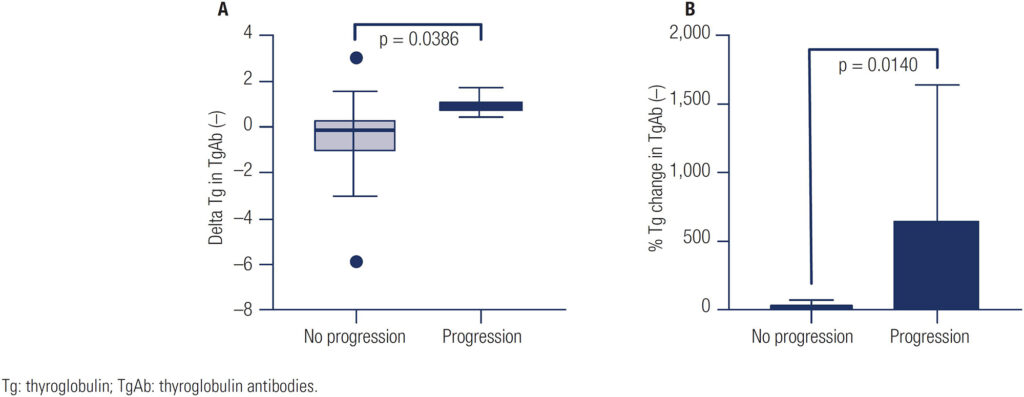
We included 32 patients: 27 (84.4%) women, age of 39 ± 14 years, all initially treated with total thyroidectomy, and 22 (69%) with therapeutic neck dissection. Cervical LN disease was diagnosed 1 year (0.3-12.6) after initial management, with a diameter of 9.0 mm (6.0-19.0). After a median AS of 4.3 years (0.6-14.1), 4 (12.5%) patients had LN growth: 2 (50%) of whom were surgically removed, 1 (25%) was effectively treated with radiotherapy, and 1 (25%) had a scheduled surgery. Tg increase was the only predictive factor of LN growth evaluated as both the delta Tg (p < 0.0366) and percentage of Tg change (p < 0.0140). None of the included patients died, had local complications due to LN growth or salvage therapy, or developed distant metastases during follow-up.
Conclusions:
In selected patients with PTC and suspicious cervical LNs diagnosed after initial treatment, AS is a feasible and safe strategy as it allows effective identification and treatment of the minority of patients who progress.