Arch Endocrinol Metab. 2025;69(2): e230493
Association between triglyceride-glucose index and the risk of type 2 diabetes mellitus

DOI: 10.20945/2359-4292-2023-0493
ABSTRACT
Objective:
To assess the efficacy of the triglyceride-glucose (TyG) index in predicting type 2 diabetes mellitus (T2DM) in the general population.
Subjects and methods:
Baseline data were collected from a community population that underwent physical examination between 2015 and 2020. The TyG index was calculated via the following formula: TyG = Ln [fasting triglyceride (mg/dL) × fasting blood glucose (mg/dL)/2]. Cox regression and stratified analyses were performed to evaluate the ability of the TyG score to predict the occurrence of diabetes.
Results:
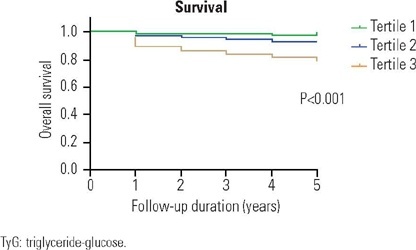
In total, 8 576 subjects were ultimately included and divided into a T2DM group (n = 882) and a non-T2DM group (n = 7,694) according to the results of the 5-year follow-up. Adjustment for all covariates revealed that every 1-unit increase in the TyG index multiplied the risk of T2DM in all the participants (HR: 3.348; 95% CI: 3.004-3.731; P < 0.001). When TyG was divided into three quantiles, the risk of T2DM in the highest quantile was 6.412 times greater than that in the lowest quantile. Subgroup analysis revealed that the correlation was more pronounced in middle-aged and young adults, females, and eutrophic individuals (interaction P value < 0.001).
Conclusion:
The TyG index can be a strong predictor of T2DM and is more useful for estimating the risk of T2DM in young and middle-aged adults, females, and eutrophic people.