Arch. Endocrinol. Metab. 2025;69(4): e250115
Associations of the fasting triglyceride glucose index with pulse wave velocity vary by age and gender

DOI: 10.20945/2359-4292-2025-0115
Abstract
Objective:
This study determined the optimal cutoff point for the triglyceride-glucose (TyG) index for predicting subclinical atherosclerosis (SA). Subjects and
methods:
Overall, 10,039 participants (5,598 men and 4,441 women) aged > 18 years were recruited from Xiamen Chang Gung Hospital. Demographic information was provided, and the TyG index was calculated. The TyG index was categorized into quartiles, and SA was assessed by measuring brachial-ankle pulse wave velocity (baPWV). The cutoff point for the TyG index was determined via receiver operating characteristic (ROC) curve analysis.
Results:
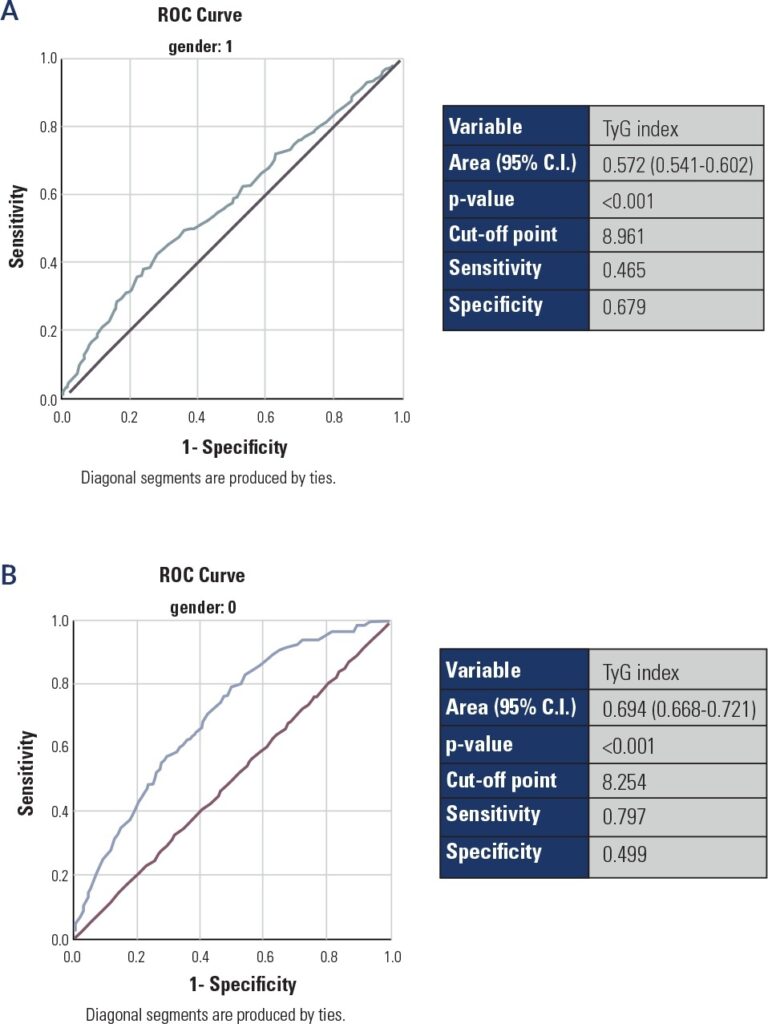
SA incidence increased with increasing TyG index in both men (from 5.929% in Group I to 10.579% in Group IV; P < 0.001) and women (from 2.074% in Group I to 14.955% in Group IV; P < 0.001). Multivariate linear regression analysis revealed that a higher TyG index was associated with an elevated risk of SA in men (odds ratio [OR] 4.028, 95% confidence interval [CI] 2.811-5.711) and women (OR 2.599, 95% CI 1.86-5.543). ROC curve analysis revealed that the area under the curve was 0.572 (95% CI = 0.541-0.602; P < 0.001) for men and 0.694 (95% CI = 0.668-0.721; P < 0.001) for women. The optimal TyG index cutoff points for predicting subclinical atherosclerosis were 8.961 for men (sensitivity, 46.5%; specificity, 67.9%) and 8.254 for women (sensitivity, 79.7%; specificity, 49.9%).
Conclusion:
The TyG index is a composite indicator of dyslipidemia and hyperglycemia. In clinical practice, women with TyG index values above the cutoff should be further evaluated for the underlying pulse wave velocity.
Keywords: age; atherosclerosis; gender; pulse wave velocity; Triglyceride-glucose index