Arch. Endocrinol. Metab. 2024;68: e230311
Budget impact analysis of cabergoline for medical treatment of Cushing’s disease in Brazil

DOI: 10.20945/2359-4292-2023-0311
ABSTRACT
Objective
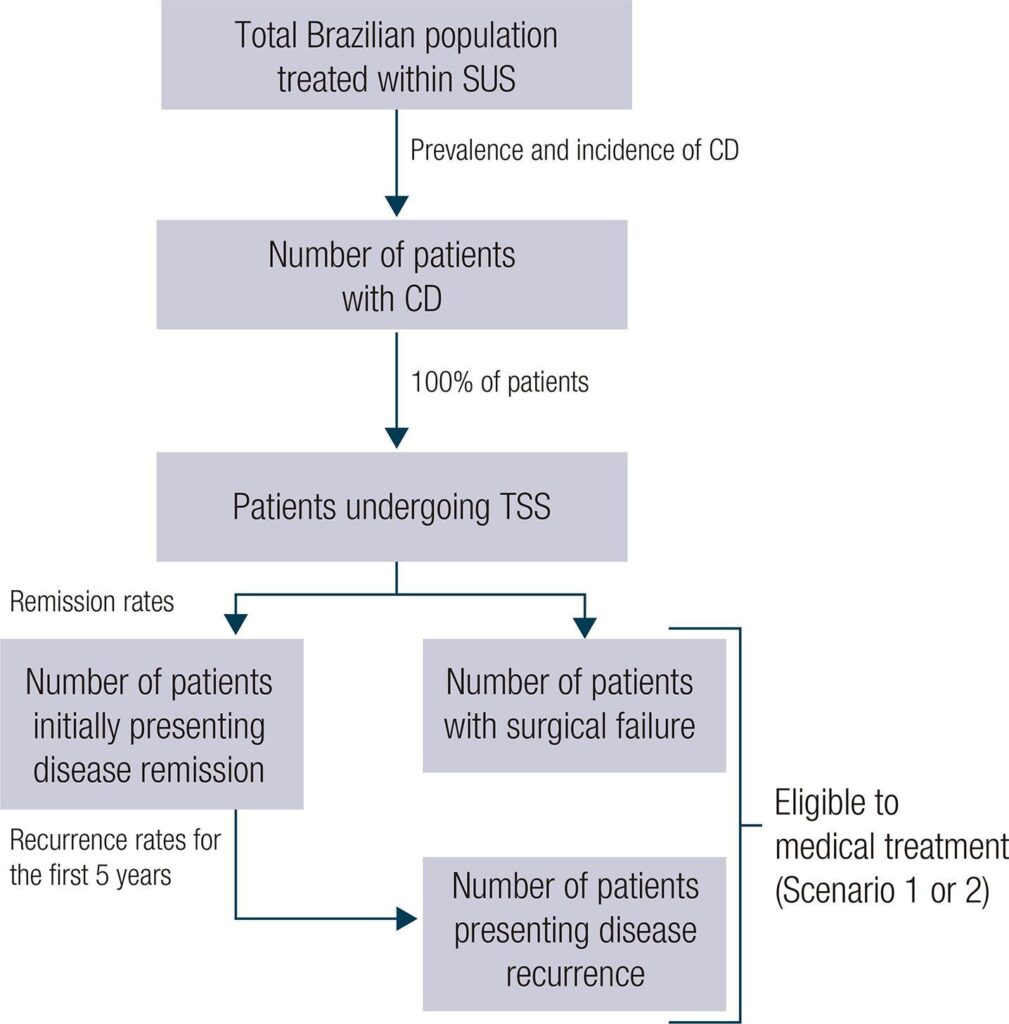
The aim of this study was to estimate the budget impact of adding cabergoline to the Brazilian Unified Health System (SUS) formulary for the treatment of patients with Cushing’s disease (CD) who do not achieve disease control after transsphenoidal surgery.
Materials and methods
We conducted a budget impact analysis (BIA) from the perspective of the Brazilian SUS over a 5-year time horizon. We compared two scenarios: ketoconazole (Scenario 1) versus including cabergoline as a treatment option (Scenario 2). All analyses were conducted using Microsoft Excel. Uncertainty was explored in univariate sensitivity analyses.
Results
The total costs were BRL $25,596,729 for Scenario 1 and BRL $32,469,169 for Scenario 2. The budget impact of adding cabergoline to the formulary for CD treatment within the SUS would be BRL $6,091,036 over 5 years. On univariate analyses, variations in the rates of surgical failure and CD recurrence had the greatest potential to affect the final costs associated with cabergoline.
Conclusions
The estimated budget impact of adding cabergoline to the formulary for CD treatment within the Brazilian SUS would be about BRL $6 million. While cost savings cannot be expected, the budget impact of adding cabergoline would be lower than that of adding other treatment options for CD.