Arch. Endocrinol. Metab. 2024;68: e230314
Clinical screening for GCK-MODY in 2,989 patients from the Brazilian Monogenic Diabetes Study Group (BRASMOD) and the Brazilian Type 1 Diabetes Study Group (BrazDiab1SG)

DOI: 10.20945/2359-4292-2023-0314
ABSTRACT
Objectives
To evaluate the accuracy of routinely available parameters in screening for GCK maturity-onset diabetes of the young (MODY), leveraging data from two large cohorts – one of patients with GCK-MODY and the other of patients with type 1 diabetes (T1D).
Materials and methods
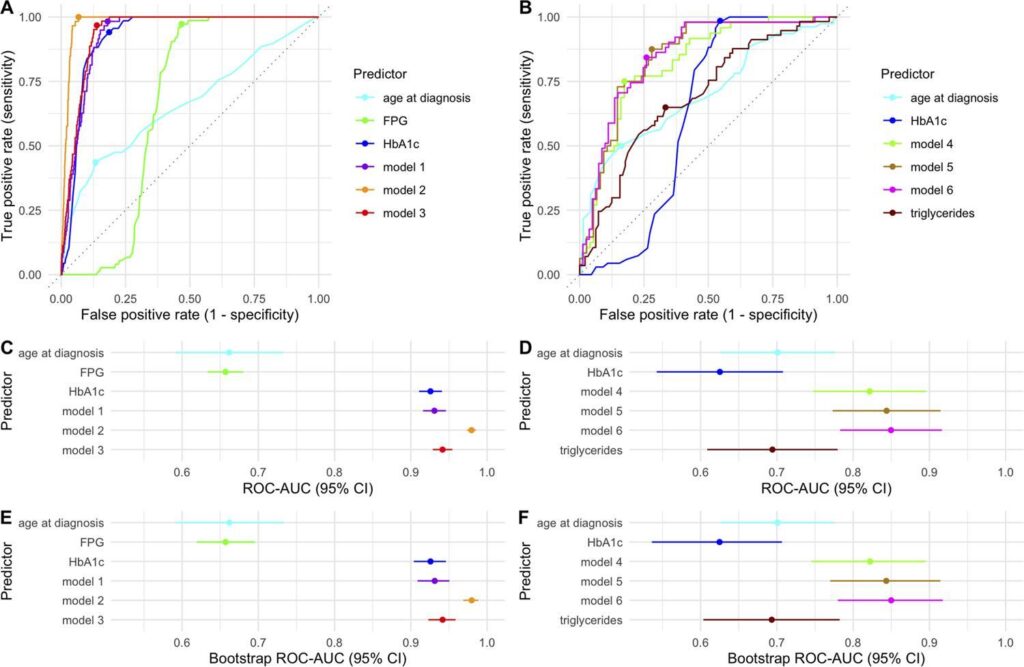
The study included 2,687 patients with T1D, 202 patients with clinical features of MODY but without associated genetic variants (NoVar), and 100 patients with GCK-MODY (GCK). Area under the receiver-operating characteristic curve (ROC-AUC) analyses were used to assess the performance of each parameter – both alone and incorporated into regression models – in discriminating between groups.
Results
The best parameter discriminating between GCK-MODY and T1D was a multivariable model comprising glycated hemoglobin (HbA1c), fasting plasma glucose, age at diagnosis, hypertension, microvascular complications, previous diabetic ketoacidosis, and family history of diabetes. This model had a ROC-AUC value of 0.980 (95% confidence interval [CI] 0.974-0.985) and positive (PPV) and negative (NPV) predictive values of 43.74% and 100%, respectively. The best model discriminating between GCK and NoVar included HbA1c, age at diagnosis, hypertension, and triglycerides and had a ROC-AUC value of 0.850 (95% CI 0.783-0.916), PPV of 88.36%, and NPV of 97.7%; however, this model was not significantly different from the others. A novel GCK variant was also described in one individual with MODY (7-44192948-T-C, p.Ser54Gly), which showed evidence of pathogenicity on in silico prediction tools.
Conclusions
This study identified a highly accurate (98%) composite model for differentiating GCK-MODY and T1D. This model may help clinicians select patients for genetic evaluation of monogenic diabetes, enabling them to implement correct treatment without overusing limited resources.
Keywords: diabetes mellitus; genetic techniques; Glucokinase; MODY; Type 1 diabetes