Arch. Endocrinol. Metab. 2026;70(2): e260021
Intact and bioactive PTH values are strongly correlated in kidney transplant recipients

DOI: 10.20945/2359-4292-2026-0021
Abstract
Objective:
This study aims to evaluate the correlation between parathyroid hormone measured by a second-generation assay (PTHG2) and by a third-generation assay (PTHG3), and their association with mineral and bone disorder (MBD) biochemical parameters and radiographic vascular calcification score in kidney transplant recipients (KTRs).
Materials and methods:
We evaluated 87 KTRs and measured PTHG2, PTHG3, biochemical profile, urinary fractional excretion of calcium (FE Ca) and phosphate, 25(OH)D3, and Kauppila score for vascular calcification. Statistical analysis: Non-parametric tests and logistic regression analysis were performed. The significance level was set to 5%.
Results:
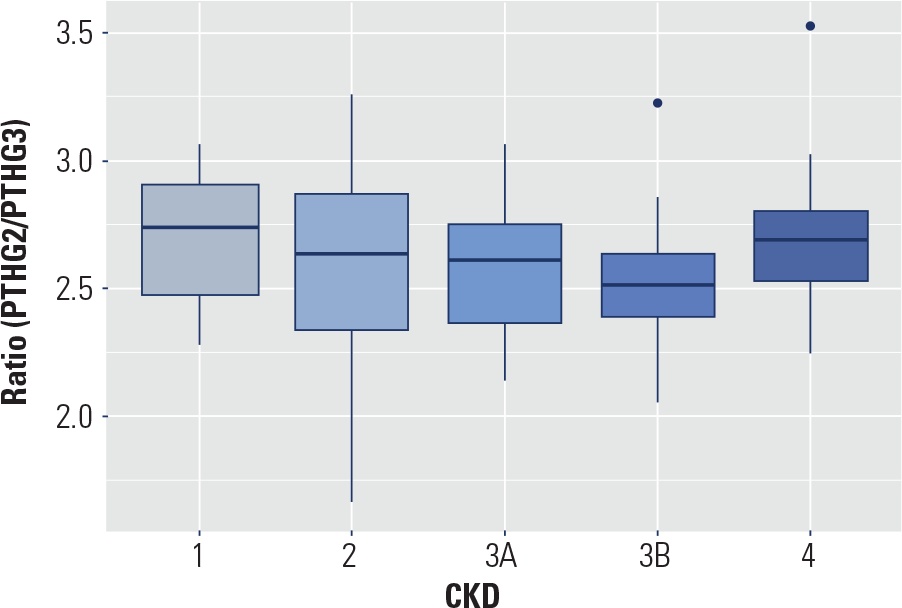
In our population, the mean age was 54 years, the mean time after transplantation was 9.4 years (± 7.6), and the mean estimated glomerular filtration rate (GFR, calculated using the Chronic Kidney Disease Epidemiology Collaboration equation – CKD-EPI) was 59.1 mL/min/1.73 m2. The correlation between PTHG2 and PTHG3 was almost perfect (r = 0.99; 95% CI = 0.98-0.99) and there was no significant difference between the PTHG2/PTHG3 ratio from different KTR-CKD stages. Investigating the association among PTH and the MBD biochemical profile, there was only correlation between PTH and FE Ca (p-value 0.01).
Conclusion:
We concluded that there is no advantage in PTHG3 dosage over PTHG2 measurement in this population.