Arch. Endocrinol. Metab. 2019;63(4):337-344
Is thyroid nodule volume predictive for malignancy?
DOI: 10.20945/2359-3997000000113
ABSTRACT
Objective:
We aimed to determine the roles of preoperative thyroid nodule diameter and volume in the prediction of malignancy.
Subjects and methods:
The medical records of patients who underwent thyroidectomy between January 2007 and December 2014 were reviewed. The nodule diameters were grouped as 5 cm3, 5-9.9 cm3 and > 10 cm3. ROC (Receiver Operating Characteristic) curve analysis was performed to find the optimal cutoff value of diameter and volume that can predict malignancy.
Results:
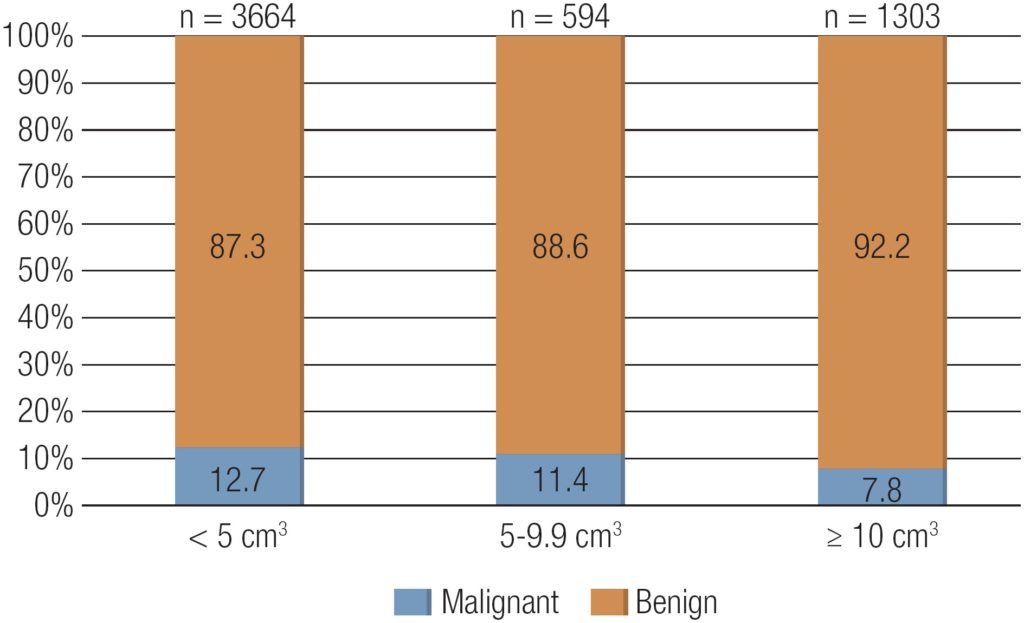
There were 5561 thyroid nodules in 2463 patients. Five hundred and forty (9.7%) nodules were < 1 cm, 2,413 (43.4%) were 1-1.9 cm, 1,600 (28.8%) were 2-3.9 cm and 1,008 (18.1%) were ≥ 4 cm. Malignancy rates were 25.6%,10.6%, 9.7% and 8.5% in nodules < 1 cm, 1-1.9 cm, 2-3.9 cm and ≥ 4 cm, respectively. When classified according to volume, 3,664 (65.9%) nodules were < 5 cm3, 594 (10.7%) were 5-9.9 cm3 and 1,303 (23.4%) were ≥ 10 cm3. The malignancy rates were 12.7%, 11.4% and 7.8% for the nodules < 5 cm3, 5-9.9 cm3 and ≥ 10 cm3, respectively (p < 0.001). In ROC curve analysis, an optimal cutoff value for diameter or volume that can predict malignancy in all thyroid nodules or nodules ≥ 4 cm could not be determined.
Conclusion:
In this surgical series, malignancy risk did not increase with increasing nodule diameter or volume. Although the volume of malignant nodules ≥ 4 cm was higher than that of benign nodules ≥ 4 cm, there was no optimal cutoff value. The diameter or volume of the nodule cannot be used to predict malignancy or decide on surgical resection.
Keywords: malignancy; nodule volume; Thyroid nodule