Arq Bras Endocrinol Metab 2014;58(5):572-582
Modifiable factors of vitamin D status among a Brazilian osteoporotic population attended a public outpatient clinic
DOI: 10.1590/0004-2730000003393
Objectives
To evaluate the serum 25-hydroxyvitamin D [25(OH)D] concentration in Brazilian osteoporotic patients and the modifiable factors of vitamin D status in this population.
Subjects and methods
In a cross-sectional study, 363 community-dwelling patients who sought specialized medical care were evaluated between autumn and spring in São Paulo, Brazil. Serum levels of 25(OH)D and parathormone (PTH), biochemical and anthropometric measurements, and bone density scans were obtained. The group was assessed using two questionnaires: one questionnaire covered lifestyle and dietary habits, skin phototype, sun exposure, medical conditions, and levels of vitamin D supplementation (cholecalciferol); the other questionnaire assessed health-related quality-of-life. Logistic regression and a decision tree were used to assess the association between the variables and the adequacy of vitamin D status.
Results
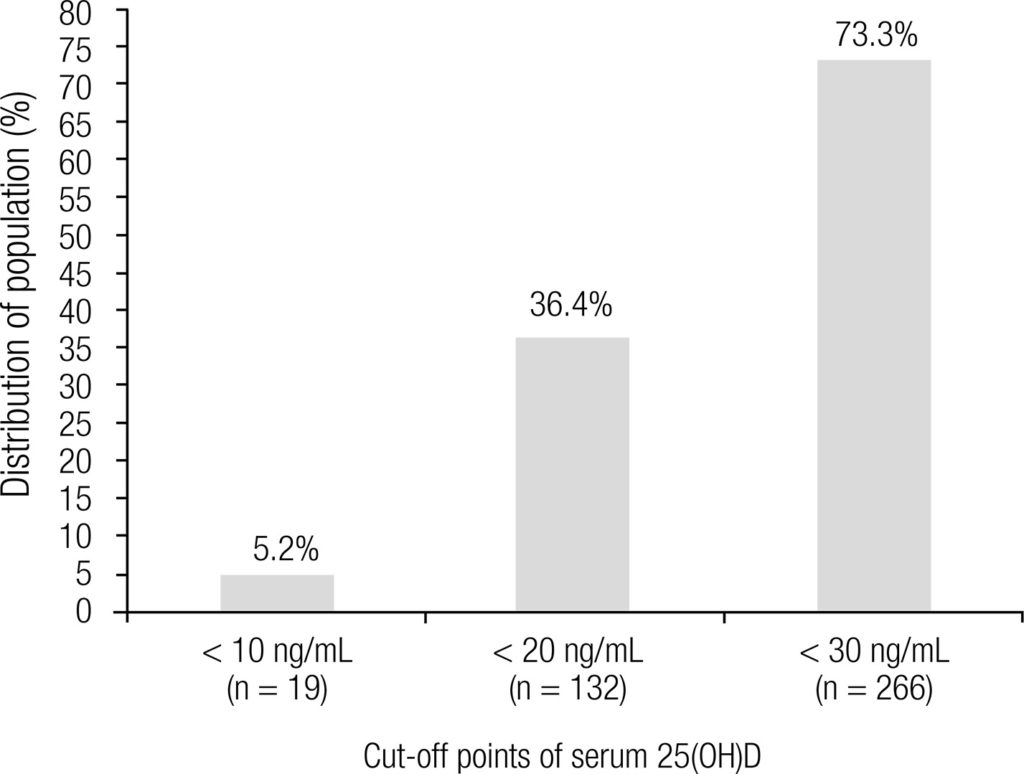
The mean age of the overall sample was 67.9 ± 8.6 years, and the mean 25(OH)D concentration was 24.8 ng/mL. The prevalence of inadequate vitamin D status was high (73.3%), although 81.5% of the subjects were receiving cholecalciferol (mean dose of 8,169 IU/week). 25(OH)D was positively correlated with femoral neck bone mineral density and negatively correlated with PTH. In the multivariate analysis, the dose of cholecalciferol, engagement in physical activity and the month of the year (September) were associated with improvement in vitamin D status.
Conclusions
In this osteoporotic population, vitamin D supplementation of 7,000 IU/week is not enough to reach the desired 25(OH)D concentration (≥ 30 ng/mL). Engagement in physical activity and the month of the year are modifiable factors of the vitamin D status in this population.
Keywords: 25-hydroxyvitamin D; Brazil; cholecalciferol; Osteoporosis; physical activity