Arch. Endocrinol. Metab. 2025;69(5): e250159
Radioactive iodine therapy outcomes in young adults with Graves disease: a bi-center observational study

DOI: 10.20945/2359-4292-2025-0159
ABSTRACT
Objective:
To evaluate the efficacy of radioactive iodine therapy and to identify determinants of treatment outcomes in young adults with Graves disease.
Methods:
This retrospective cohort study analyzed young adults with Graves disease who underwent radioactive iodine therapy at two tertiary medical centers in Southwest China. Patients were stratified into two groups based on therapy outcomes at 6 months post-radioactive iodine therapy: euthyroidism or hypothyroidism (therapy success) and persistent hyperthyroidism necessitating either a second radioactive iodine therapy or continuation of anti-thyroid drug therapy (therapy failure). Multivariate logistic regression and receiver operating characteristic curve analyses were employed to assess predictive factors for treatment outcome.
Results:
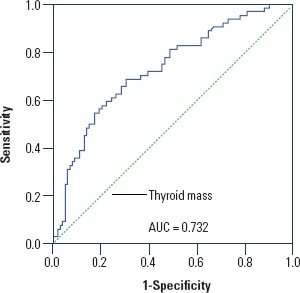
A cohort of 163 young adults with Graves disease, with a mean age of 18 years (range: 6 to 20 years) were included. The overall therapy success rate was 60.7%. Multivariate regression analysis identified that thyroid mass (OR 1.013, 95%CI 1.002 – 1.025; p-value = 0.022) and interval between diagnosis and radioactive iodine therapy (> 1 year; OR 2.471, 95%CI 1.128 – 5.415; p-value = 0.024) were risk factors associated with therapy failure. ROC curve analysis identified 38 g as the optimal thyroid mass cutoff for predicting treatment failure, demonstrating a sensitivity of 69% and specificity of 70%. The positive and negative predictive values were 60% and 78%, respectively.
Conclusion:
A therapy success rate of 60.7% was observed in radioactive iodine therapy in young adults with Graves disease. Larger thyroid volume and prolonged disease duration emerged as significant risk factor for therapy failure.
Keywords: Graves' disease; Radioactive iodine; Young adults